
The Home Symptom: You’ve probably added plants to your home for a touch of greenery, perhaps hoping they’d “clean the air.” But if you’re still feeling stuffy, stressed, or battling a vague sense of urban disconnect, you might be missing the deeper, scientific power of biophilic design. It’s time to move beyond pretty pots and create true “green lung” zones in your home.
At HomedWell, we understand that plants are more than just decor; they are sophisticated biological filters and profound psychological anchors. By integrating them strategically, you can transform your home into a truly functional ecosystem that purifies the air and calms your nervous system.
The Clinical Deep Dive: From NASA to Your Nervous System
For decades, the idea of plants as indoor air purifiers was largely anecdotal. Then, in 1989, NASA’s Clean Air Study revolutionized our understanding. Researchers found that common houseplants could effectively remove airborne toxins like benzene, formaldehyde, and trichloroethylene from sealed environments. While larger volumes of plants are needed for significant whole-house filtration, the study provided the foundational evidence for plants’ biological prowess.
However, biophilic design extends far beyond mere filtration. Modern wellness science now focuses on how our innate connection to nature—biophilia—impacts our mental and physical health. A key aspect of this is the concept of fractal patterns. These are complex, self-repeating patterns found everywhere in nature, from fern fronds to coastlines. Research by Richard Taylor, a physicist at the University of Oregon, has demonstrated that viewing these naturally occurring fractal patterns can reduce physiological stress, measured by decreased sympathetic nervous system activation (our “fight or flight” response) and improved heart rate variability.
Furthermore, plants actively participate in regulating indoor humidity through transpiration. This process, where plants release water vapor through their leaves, can subtly increase local humidity levels. This is crucial because optimal indoor humidity (between 40-60%) reduces the spread of airborne viruses, alleviates dry skin and respiratory irritation, and even enhances the efficacy of other air purification methods.
The HomedWell Solution: Cultivating Functional Green Lungs
Moving beyond aesthetics, here’s how to integrate plants for maximum air quality benefits and stress reduction:
1. Identify “Micro-Greenhouse” Zones
- Strategy: Recognize that different areas of your home offer unique microclimates. Bathrooms, laundries, and even certain kitchen corners often have higher humidity and less fluctuating temperatures.
- Why it Works: These areas are ideal for plants that thrive on moisture and can, in turn, contribute to local humidity regulation, creating a functional “micro-greenhouse.”
- HomedWell Tip: Use a simple hygrometer to measure humidity in different rooms. Areas consistently below 40% benefit most from plant-based humidification.
2. Pair High-Transpiration Plants with Humid Microclimates
- Strategy: Select plants known for their high transpiration rates and air-purifying capabilities.
- Why it Works: Grouping these plants in naturally humid areas amplifies their ability to release water vapor, creating a localized humidity bubble that benefits both the plants and your respiratory health.
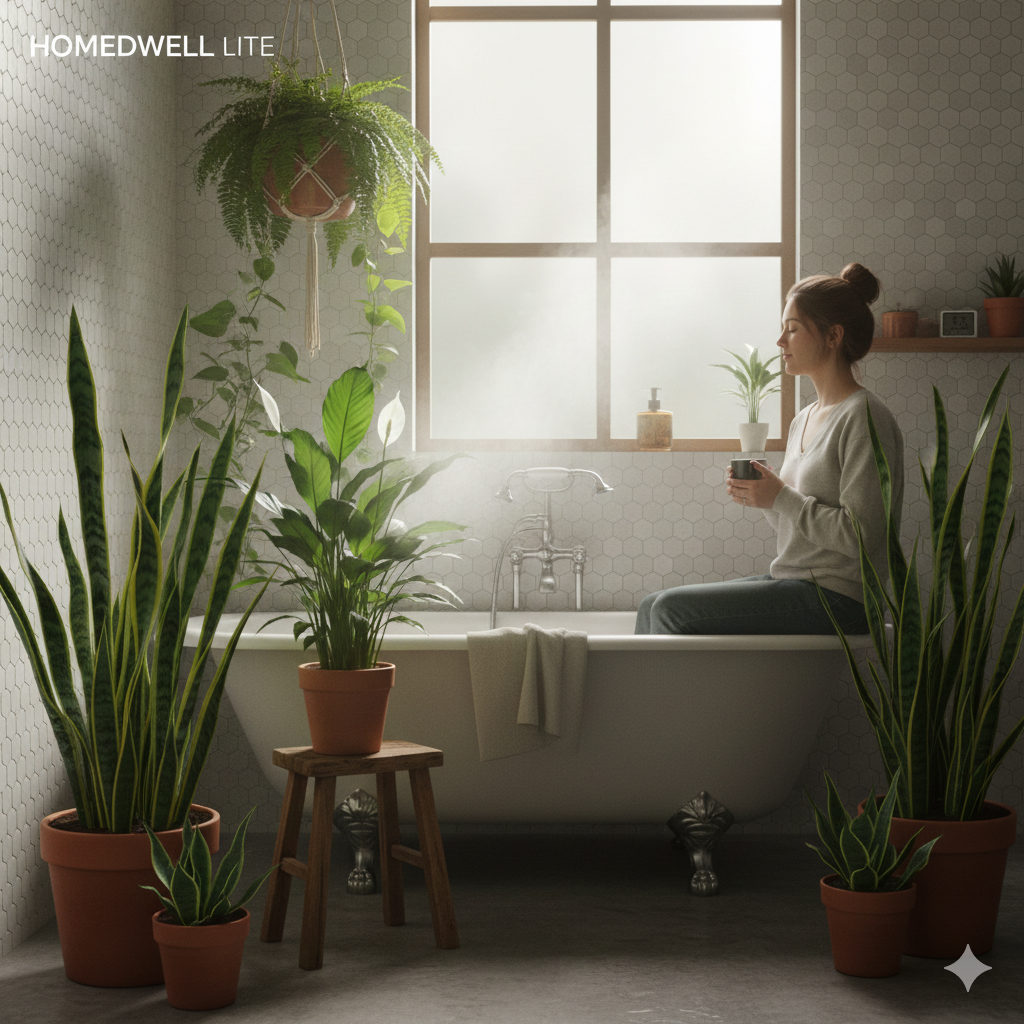
- Peace Lily (Spathiphyllum): Excellent at transpiring moisture and removing common VOCs. Perfect for bathrooms.
- Snake Plant (Sansevieria trifasciata): Unique in that it converts $CO_2$ to oxygen at night, making it ideal for bedrooms. Also a great VOC filter.
- Spider Plant (Chlorophytum comosum): Easy to care for and highly effective at removing formaldehyde and xylene.
- Boston Fern (Nephrolepis exaltata ‘Bostoniensis’): A humidity-loving plant with high transpiration and beautiful fractal patterns.
- HomedWell Tip: Cluster 3-5 plants of varying sizes together. The combined surface area dramatically increases their functional impact compared to scattered individual plants.
3. Integrate Fractal Patterns for Stress Reduction
- Strategy: Position plants with visually complex, fractal-rich foliage in areas where you seek calm or focus.
- Why it Works: Looking at plants with intricate patterns (like ferns, succulents, or even the branching of a large Ficus) subconsciously engages your visual cortex in a way that is inherently soothing, tapping into our innate biophilic preference.
- HomedWell Tip: Place a lush fern on your desk, or a large, naturally shaped plant in your reading nook. The subtle visual engagement provides “micro-restorative breaks” for your brain.
Your Home: A Living, Breathing Ecosystem
By thoughtfully selecting and placing plants, you’re not just adding greenery; you’re actively engaging in biophilic air filtration and creating environments that scientifically reduce stress. Your home becomes a truly living, breathing ecosystem, working in harmony with your well-being.
References & Further Reading
- NASA Clean Air Study: Wolverton, B. C., Johnson, A., and Bounds, K. 1989. Interior Landscape Plants for Indoor Air Pollution Abatement. National Aeronautics and Space Administration, John C. Stennis Space Center. MS 39529-6000 https://foobot.io/dl/NASA-interior-landscape-plants-for-indoor-air-pollution-abatement.pdf
- Fractal Stress Reduction: Taylor RP, Spehar B, Wise JA, Clifford CW, Newell BR, Hagerhall CM, Purcell T, Martin TP. Perceptual and physiological responses to the visual complexity of fractal patterns. Nonlinear Dynamics Psychol Life Sci. 2005 Jan;9(1):89-114. PMID: 15629069. https://pubmed.ncbi.nlm.nih.gov/15629069/
- Biophilia and Health: Kellert, S. R. (2012). Birthright: People and Nature in the Modern World. Yale University Press. A key text exploring the scientific basis and benefits of biophilia. Find on Google Scholar
- Han KT, Ruan LW. Effects of indoor plants on air quality: a systematic review. Environ Sci Pollut Res Int. 2020 May;27(14):16019-16051. doi: 10.1007/s11356-020-08174-9. Epub 2020 Mar 13. PMID: 32170619. https://pubmed.ncbi.nlm.nih.gov/32170619/
Categories:
- Biophilic Design
- Indoor Air Quality
- Stress Reduction
- Home Wellness