Using Spectral Tuning to Sync Your Internal Clock
We spend nearly 90% of our lives indoors, shielded by drywall and double-paned glass. While our architecture has evolved for comfort, our biology remains anchored to the movement of the sun. This disconnect is the primary driver of “Social Jetlag”—a state where your home environment actively fights your internal clock.
At HomedWell, we believe your home should be a biological catalyst, not a barrier. By understanding the science of Spectral Lux, you can turn your living space into a tool for better sleep, sharper focus, and emotional resilience.
The Gatekeepers of Your Energy: Understanding ipRGCs
For decades, we believed the eye only existed to form images. However, in the early 2000s, researchers discovered a third type of photoreceptor: intrinsically photosensitive Retinal Ganglion Cells (ipRGCs).
Unlike rods and cones, these cells don’t help you see the furniture; they help you feel the time of day. These cells contain a photopigment called melanopsin, which is exquisitely sensitive to short-wavelength “blue” light (peaking around $480nm$).
When these cells detect blue-rich light (like the morning sun), they send a direct signal to the Suprachiasmatic Nucleus (SCN)—your brain’s master clock—to suppress melatonin and trigger a healthy spike in cortisol. This is your biological “ignition switch.”
The Science of the “Morning Spike”
A seminal study published in the Journal of Biological Rhythms highlights that the timing, duration, and intensity of light exposure are the three pillars of circadian health.
If your morning environment is dim or relies on warm, low-intensity bulbs, your body never receives the “daytime” signal. This leads to lingering sleep inertia and a delayed melatonin onset at night. To fix this, we look at Vertical Illuminance—the light hitting your eye vertically, rather than the light pooling on your floor.
The HomedWell Design Strategy: Spectral Tuning Your Home
To optimize your home for circadian health, we categorize your rooms into two “Spectral Zones.”
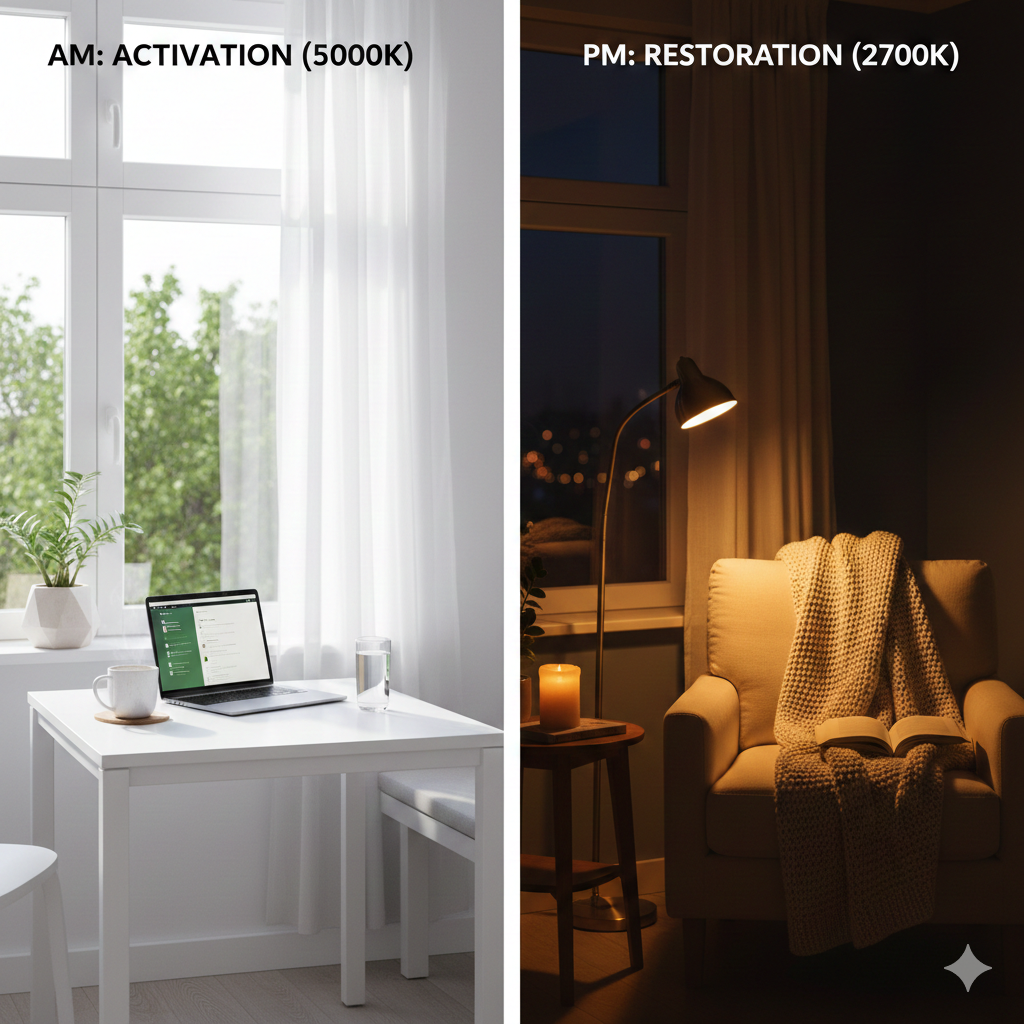
1. The Activation Zone (6:00 AM – 2:00 PM)
Target Areas: Breakfast nooks, home offices, and bathrooms.
-
The Lux Goal: Aim for at least 250–500 melanopic lux at the eye level.
-
Design Action: Position your workspace within 3 feet of a window. If your home lacks natural light, utilize LED panels with a Color Temperature (CCT) of 5000K to 6500K.
-
Biological Result: Immediate suppression of melatonin and stabilized mood through serotonin synthesis.
2. The Melatonic Bridge (8:00 PM – Bedtime)
Target Areas: Living rooms and bedrooms.
-
The Lux Goal: Transition to “Warm-Dim” technology.
-
Design Action: Switch to bulbs with a CCT of 2700K or lower. Ensure light sources are placed low in the room (floor lamps rather than recessed ceiling lights). Low-angle light mimics the setting sun and is less likely to trigger the ipRGCs.
-
Biological Result: A natural rise in melatonin, allowing you to reach Deep Sleep (Stage 3) faster.
[Image showing light bulb color temperatures from 1000K candle light to 10000K blue sky]
Designing for the “Lite” Lifestyle
You don’t need a million-dollar smart home system to achieve spectral tuning. Circadian design is about intentional placement. * Audit your Windows: Which microclimate in your home gets the first 2 hours of direct sun? That is your “Activation Microclimate.”
-
Swap your Bulbs: Replace your bedside “cool white” bulbs with amber-toned LEDs.
Your home is the most sophisticated medical device you own. When you align your architecture with your biology, wellness stops being a chore and starts being an atmospheric constant.
References & Further Reading
-
On ipRGCs and Mood: Fernandez, D. C., et al. (2018). Light affects mood and learning through distinct retina-brain pathways. National Institute of Mental Health (NIMH). This study identifies the specific neural pathways from the eye to the brain’s mood centers, independent of vision. https://pubmed.ncbi.nlm.nih.gov/30173913/
-
The Consensus on Melanopic Lux: Brown, T. M., et al. (2022). Recommendations for daytime, evening, and nighttime indoor light exposure to best support circadian health, sleep, and well-being. PLOS Biology. This is the foundational peer-reviewed paper that established the 250 lux m-EDI (melanopic Equivalent Daylight Illuminance) standard for daytime interiors. https://pmc.ncbi.nlm.nih.gov/articles/PMC8929548/
-
On Evening Melatonin Suppression: Home lighting, blue-light filtering, and their effects on melatonin suppression. (2026). Scientific Reports (Nature). A recent systematic evaluation showing that “cool” white LEDs induce significantly higher melatonin suppression than “warm” white bulbs in residential settings. https://www.nature.com/articles/s41598-025-29882-7
-
Architectural Application: Jalali, M.S., et al. (2024). Human-Centric Lighting Design: A Framework for Supporting Healthy Circadian Rhythm Grounded in Established Knowledge in Interior Spaces. Buildings. A recent framework for designers to bridge the gap between clinical light research and residential floor plans. https://www.mdpi.com/2075-5309/14/4/1125
-
Sunlight and Sleep Quality: The role of sunlight in sleep regulation: analysis of morning, evening and late exposure. (2025). PMC (National Institutes of Health). Research confirming that every 30-minute increment of morning sun exposure correlates with improved sleep quality and earlier sleep onset. https://pmc.ncbi.nlm.nih.gov/articles/PMC12502225/