
Designing for Morning Energy
The Home Symptom: Do you stumble into your kitchen, grab coffee, and still feel like you’re moving through treacle? That morning sluggishness isn’t just about sleep debt; it might be your kitchen fighting your biology. The light you experience while breaking your fast is a powerful signal to your brain, setting the tone for your energy, focus, and even your sleep later that night.
At HomedWell, we believe your kitchen should be an engine for well-being, not just a place for meals. By understanding the science of spectral lux and strategic placement, you can transform your kitchen into a powerful tool for boosting morning energy and anchoring your entire circadian rhythm.
The Clinical Deep Dive: Your Kitchen’s Secret Power Switch
Our bodies are exquisitely tuned to the natural light cycle. Specialized photoreceptors in our eyes, called intrinsically photosensitive Retinal Ganglion Cells (ipRGCs), act as our internal “light meters.” These cells are most sensitive to blue light around $480nm$, and when they detect it, they send signals to your brain’s master clock (the Suprachiasmatic Nucleus, or SCN).
This morning dose of blue-rich light is your biological “on” switch. It suppresses melatonin production (the sleep hormone) and initiates a healthy cortisol spike, signaling to your body that it’s time to be awake, alert, and focused. Without this crucial signal, your body struggles to fully wake up, leading to lingering grogginess, reduced cognitive function, and even a delay in evening melatonin onset.
Conversely, exposure to bright, blue-rich light in the evening can severely disrupt sleep. As evening approaches, your environment should shift to warmer, lower-intensity light to allow melatonin production to ramp up naturally, preparing you for restorative sleep. This balance is critical, and your kitchen, as a high-traffic area, plays a disproportionately large role.
References & Further Reading
On ipRGCs and Melatonin Suppression: Brainard, G. C., et al. (2015). Action spectrum for melatonin regulation in humans: evidence for a novel photoreceptor system. Journal of Neuroscience. This foundational study details the specific wavelengths responsible for melatonin suppression and the role of ipRGCs. https://pubmed.ncbi.nlm.nih.gov/11487664/
Chellappa SL, Steiner R, Blattner P, Oelhafen P, Götz T, Cajochen C. Non-visual effects of light on melatonin, alertness and cognitive performance: can blue-enriched light keep us alert? PLoS One. 2011 Jan 26;6(1):e16429. doi: 10.1371/journal.pone.0016429. PMID: 21298068; PMCID: PMC3027693. https://pubmed.ncbi.nlm.nih.gov/21298068/
Houser K, Boyce P, Zeitzer J, Herf M. Human-centric lighting: Myth, magic or metaphor? Lighting Research & Technology. 2020;53(2):97-118. doi:10.1177/1477153520958448 https://journals.sagepub.com/doi/abs/10.1177/1477153520958448
Leproult R, Colecchia EF, L’Hermite-Balériaux M, Van Cauter E. Transition from dim to bright light in the morning induces an immediate elevation of cortisol levels. J Clin Endocrinol Metab. 2001 Jan;86(1):151-7. doi: 10.1210/jcem.86.1.7102. PMID: 11231993. https://pubmed.ncbi.nlm.nih.gov/11231993/
- Figueiro MG. Disruption of Circadian Rhythms by Light During Day and Night. Curr Sleep Med Rep. 2017 Jun;3(2):76-84. doi: 10.1007/s40675-017-0069-0. PMID: 28845384; PMCID: PMC5568574. https://pmc.ncbi.nlm.nih.gov/articles/PMC5568574/
The HomedWell Solution: Design Your Circadian Kitchen
Transforming your kitchen for morning energy is about intentional design, blending natural light with smart artificial illumination.
1. The East-Facing Breakfast Nook: Your Natural Alarm Clock
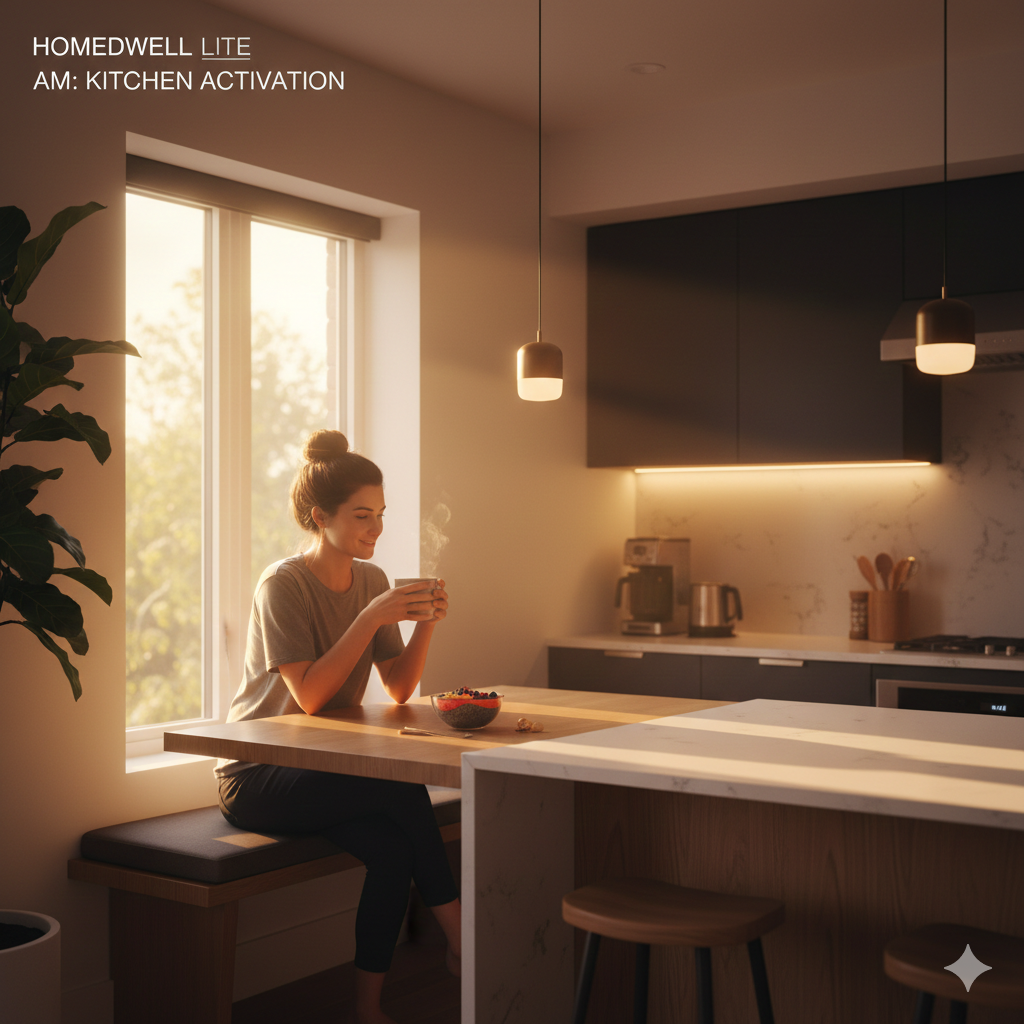
Strategy: Position your primary breakfast spot—a small table, a bar stool, or a counter—as close as possible to an east-facing window.
Why it Works: This maximizes your exposure to the direct, blue-rich morning sunlight. Even 15-30 minutes of this exposure while you eat can powerfully signal your SCN, initiating that vital cortisol spike and sharpening your focus for the day ahead.
HomedWell Tip: Clear window treatments during morning hours. Consider sheer blinds or curtains that can be easily pulled back to let the light flood in.
2. Strategic “Blue-Enriched” Task Lighting
Strategy: For areas where you prepare food in the morning, or if you lack an east-facing window, incorporate LED task lighting with a higher Color Temperature (CCT) of 4000K-5000K.
Why it Works: This provides the necessary spectral input to stimulate your ipRGCs, even on cloudy days or in shaded kitchens. This type of light promotes alertness and helps reduce morning grogginess.
HomedWell Tip: Install LED strips under upper cabinets or use focused spotlights over prep areas. Ensure these lights are easily switchable, allowing you to dim or change their temperature as the day progresses.
3. The “Warm-Dim” Evening Transition
Strategy: Install “warm-dim” LED technology or smart bulbs in your general kitchen lighting (e.g., overhead fixtures, pendant lights over an island).
Why it Works: As evening approaches, your kitchen needs to transition. Warm-dim bulbs automatically shift to a lower CCT (e.g., 2200K-2700K) as they are dimmed. This mimics the setting sun, reducing blue light exposure and allowing natural melatonin production to begin without disrupting your dinner prep or evening snacks.
HomedWell Tip: Set timers or use smart home systems to automatically shift your kitchen’s lighting to warmer, lower-intensity settings after sunset. This subtle change supports your body’s natural wind-down process.
SEO Keyword WP Tags
Categories:
Circadian Health
Kitchen Design
Sleep Optimization
Home Wellness